FACT: Alan Wozniak helped turn an average company into a four-time INC. 5000 business, achieving 370% growth in its final four years before selling the company through an M&A transaction to a Fortune 500 company.
Sounds great when you put it into one sentence, doesn’t it?
But that sentence leaves out the most important part of the story.
It leaves out the years when the finish line wasn’t visible. The decisions that didn’t work. The long days. The missed opportunities. The constant adjustments. And the times when it would have been easier to say, “Maybe this just isn’t going to happen.”
That’s the part of business success we don’t talk about enough.
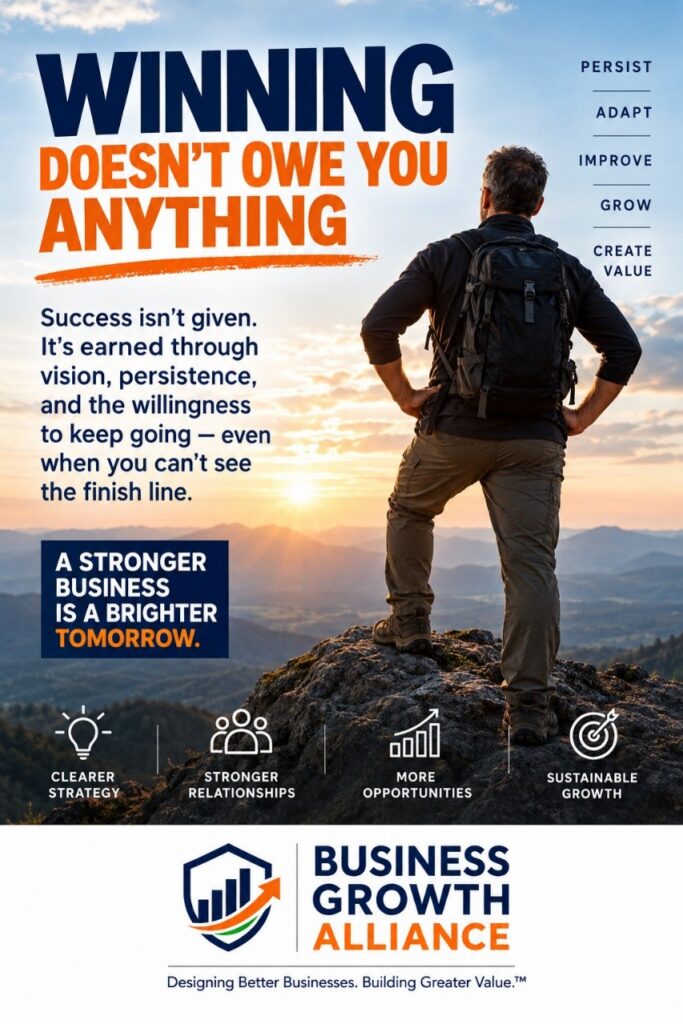
Winning doesn’t owe you anything.
It doesn’t care how many hours you worked last week. It doesn’t care how much money you invested, how many sacrifices you made, or how badly you want your company to succeed.
Hard work matters. But hard work alone doesn’t guarantee growth.
Sometimes you can do everything you think is right and still not see immediate results.
The real question becomes:
Will you keep moving when you can’t see the finish line?
When I look back at building my company, people naturally focus on the highlights.
Four-time INC. 5000 company.
370% growth in four years.
Successful sale to a Fortune 500 company.
Those are great milestones. I’m proud of them.
But they weren’t the result of one brilliant idea, one incredible salesperson, one marketing campaign, or one lucky break.
They were the result of thousands of decisions made over many years.
Some were right.
Some were wrong.
Some worked immediately.
Others took months or even years to pay off.
That’s business.
You keep learning. You keep adjusting. And most importantly, you keep moving.
Business owners love to talk about growth, but real growth can be messy.
One month, everything seems to click. Leads are coming in. Sales are up. The team is energized.
The next month?
Nothing seems to work.
That doesn’t necessarily mean your strategy is wrong.
And it certainly doesn’t mean you should abandon everything and chase the newest marketing trend.
Sometimes you need to stay the course.
Other times, you need to change the course.
Knowing the difference is where good leadership comes in.
Being persistent doesn’t mean repeatedly doing something that isn’t working. It means staying committed to the destination while being willing to change how you get there.
The goal can remain the same even when the plan changes.
This is especially important when it comes to marketing and sales.
Businesses are busier than ever.
We’re posting on LinkedIn.
Sending emails.
Running ads.
Creating videos.
Updating websites.
Using AI.
Writing blogs.
Building funnels.
But here’s the uncomfortable question:
Is all that activity actually growing the business?
You can have thousands of website visitors and very few qualified leads.
You can have social media engagement without generating meaningful sales conversations.
You can send thousands of emails without creating a healthy pipeline.
Activity is easy to measure.
Progress is harder.
That’s why every business owner should regularly ask:
Who are we trying to reach?
What problem are we solving for them?
Is our message clear?
Does our marketing connect directly to our sales process?
Are we following up consistently?
And are we measuring the things that actually matter?
Here’s an even simpler test:
If your marketing disappeared tomorrow, would your sales team notice?
If the answer isn’t an immediate yes, something probably needs to change.
One of the biggest lessons I learned over decades in business is that the answer isn’t always “do more.”
Sometimes the answer is do better.
A clearer message may outperform a larger advertising budget.
Better follow-up may create more revenue than generating another thousand leads.
A stronger customer experience may produce more referrals than another social media campaign.
Improving your sales process may generate greater growth without increasing marketing spending at all.
That’s why we believe business growth needs to be looked at as an entire system.
Marketing doesn’t operate by itself.
Neither does sales.
Neither do operations, finances, culture, customer experience, problem solving, or business value.
They are connected.
When one area is weak, it can hold back the rest of the company.
That thinking is at the heart of Business Growth Alliance (BGA)—a connected business growth ecosystem designed to help owners build stronger companies, accelerate growth, and create greater long-term value.
BGA brings together four complementary resources under one alliance: Business Health Matters for executive coaching and business strategy; MarketWell Solutions for done-for-you digital marketing and lead generation; 10XCoach.ai for AI-powered business coaching and operating systems; and AlanWozniak.com, featuring The Small Business BIG EXIT and So You HATE Selling—practical business books built from real-world entrepreneurial experience.
Together, they address a simple reality: business growth rarely comes from fixing just one thing.
It comes from strengthening the entire business—from leadership, sales, and marketing to operations, customer experience, profitability, and ultimately, business value.
That’s the purpose of Business Growth Alliance: Designing Better Businesses. Building Greater
We’re not interested in marketing for the sake of marketing or strategy that sits in a binder collecting dust.
We want to help business owners answer three practical questions:
Where are we now?
Where do we want to go?
What needs to happen next to close the gap?
Through the Business Growth Alliance and its family of business growth resources, we help companies look at the bigger picture—from business coaching and marketing to AI-powered business tools and practical education.
Sustainable growth rarely comes from fixing one isolated problem.
It comes from building a healthier business.
Build a Business Worth Something
My experiences building and eventually selling my company also led me to write The Small Business BIG EXIT and So You HATE Selling.
Although the books address different challenges, they share an important idea:
Build your business deliberately.
Don’t wait until you’re ready to sell to start thinking about business value.
Don’t wait until sales slow down to create a sales process.
Don’t wait until leads disappear to start marketing.
And don’t wait until everything feels broken before figuring out where your weaknesses are.
The strongest businesses are built before they desperately need to be fixed.
That requires discipline.
It requires measurement.
It requires honest conversations.
And yes, it requires a little stubbornness.
Keep Showing Up
There will be bad months.
There will be campaigns that flop.
There will be prospects who disappear.
There will be employees who don’t work out, strategies that need to change, and opportunities you wish you had handled differently.
That’s part of building a business.
You learn.
You adjust.
You get smarter.
And then you make the next decision.
Winning doesn’t owe you anything.
But you can stack the odds in your favor.
Keep showing up.
Keep measuring.
Keep improving.
Keep building relationships.
Keep solving real problems.
Keep making the next smart decision.
Because in business, the finish line isn’t always visible.
Sometimes the companies that ultimately win are simply the ones that continue building long enough—and intelligently enough—to reach it.
Design a better business. Build greater value.
Business Growth Alliance
Ready to find out where your business is strong—and where growth may be getting stuck?
Take the FREE Business Success Quiz and discover how your business performs across the key pillars that drive sustainable growth.
About the Author
Alan Wozniak is an entrepreneur, business architect, and author of The Small Business BIG EXIT and So You HATE Selling. He spent 35 years building Pure Air Control Services, growing the company 370% in its final four years before selling it to a Fortune 500 company. Today, through Business Growth Alliance, Alan helps business owners solve problems, build stronger companies, and create lasting value. His approach is simple: be a business architect, ask better questions, and focus on solving problems.
Learn more at AlanWozniak.com.